
India’s Population Dividend: Opportunity or Demographic Burden?
Introduction – The Population Debate in India
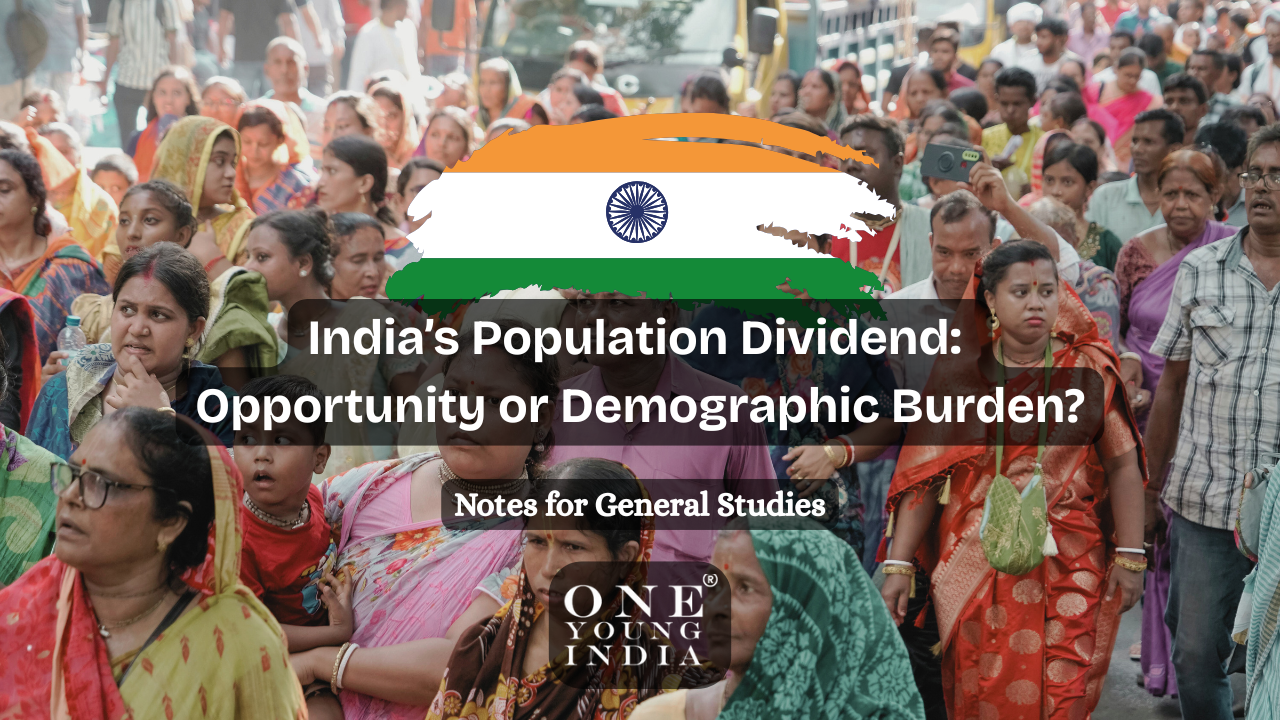
India recently surpassed China to become the most populous country in the world, with over 1.4 billion people. For some, this milestone represents a massive opportunity—a young workforce that could drive economic growth and innovation for decades to come. For others, it signals a looming crisis—strain on resources, rising unemployment, and pressure on infrastructure.

This duality lies at the heart of the debate: Is India’s population a dividend that can transform it into an economic superpower, or a demographic burden that risks instability? The answer depends on how effectively India manages education, employment, healthcare, and governance in the coming decades.
What is a Demographic Dividend?
Definition and Concept
A demographic dividend refers to the economic growth potential that arises when a country’s working-age population (15–64 years) is larger than the non-working-age population (children and elderly). With fewer dependents to support, the workforce can boost productivity, savings, and consumption.
Global Examples
East Asia (1970s–1990s): Countries like South Korea and Singapore harnessed their demographic dividend through education, industrialization, and exports, becoming economic powerhouses.
Ireland: In the 1990s, investments in education and technology allowed Ireland to benefit from its youthful workforce, leading to rapid economic growth.
India now stands at a similar crossroads, with its working-age population accounting for more than 65% of the total.
India’s Demographic Profile
Youthful Population
Over 50% of India’s population is under 30. By 2030, India will add nearly 100 million people to its working-age population. This youth bulge is both a strength and a challenge, depending on how jobs and skills are developed.
Regional Variations
India’s demographic dividend is not uniform. States like Kerala and Tamil Nadu are aging faster, while Bihar and Uttar Pradesh still have very young populations. This creates uneven opportunities and risks across regions.
Dependency Ratio
India’s dependency ratio—non-working-age population relative to working-age population—is falling, which should theoretically boost savings and investment. However, without sufficient employment opportunities, this potential remains untapped.
Opportunities from India’s Population Dividend
1. Economic Growth and Productivity
A large working-age population can drive GDP growth by increasing labor supply. According to the IMF, India’s demographic dividend could add 2% to annual GDP growth if properly harnessed.
2. Innovation and Startups
India’s youth are increasingly turning to entrepreneurship. The country now has over 100 unicorn startups, driven by tech-savvy millennials. This innovative spirit could transform India into a global startup hub.
3. Expanding Consumer Market
With a young, aspirational middle class, India’s domestic market is set to boom. Rising consumption in sectors like e-commerce, entertainment, education, and healthcare presents massive opportunities for businesses.
4. Global Labor Force
India’s youth could help fill labor shortages in aging economies like Japan, Europe, and the U.S. Through migration, outsourcing, and remote work, Indian workers can contribute globally while bringing remittances home.
5. Demographic Advantage in Defense and Security
A youthful population ensures a steady supply of manpower for defense and security forces, strengthening India’s strategic capabilities.
Challenges of a Large Population
1. Unemployment and Job Creation
India adds over 10 million new workers to the labor force annually, but job creation has not kept pace. Unemployment, especially among educated youth, is rising. Without adequate jobs, the demographic dividend risks turning into a demographic disaster.
2. Education and Skill Gaps
India’s education system faces challenges of quality, accessibility, and relevance. Many graduates lack industry-ready skills, leading to a mismatch between education and employment needs.
3. Healthcare Burden
A large population requires massive investment in healthcare infrastructure. Malnutrition, maternal mortality, and lifestyle diseases still affect productivity and life expectancy. Without robust healthcare, India’s workforce cannot remain competitive.
4. Urbanization and Infrastructure Strain
Rapid urban migration has created overcrowded cities, housing shortages, and pressure on transport, water, and sanitation. If infrastructure does not keep up, urban chaos could undermine economic growth.
5. Environmental Stress
Population pressure accelerates deforestation, pollution, and climate challenges. Water scarcity, air quality deterioration, and agricultural stress threaten sustainable development.
India’s Readiness to Harness the Dividend
Education and Skill Development
Schemes like Skill India Mission, National Education Policy (NEP) 2020, and vocational training initiatives aim to equip youth with employable skills. However, implementation and reach remain uneven.
Employment and Industrial Policy
India needs to boost labor-intensive manufacturing sectors like textiles, electronics, and food processing. At the same time, the digital economy offers new opportunities in IT, fintech, and gig work.
Healthcare Investments
Ayushman Bharat and other programs aim to expand healthcare access. Preventive healthcare, telemedicine, and digital health can improve workforce productivity.
Gender Inclusion
India’s female labor force participation is only about 25%. Empowering women through education, safety, and equal opportunities could double the effective workforce, amplifying the demographic dividend.
Demographic Dividend vs. Demographic Burden
When it Becomes a Dividend
Quality education and vocational training
Job-rich industrial growth
Robust healthcare system
Inclusive labor participation (especially women)
Effective governance and policy implementation
When it Becomes a Burden
Rising unemployment
Widening inequality
Social unrest from frustrated youth
Resource depletion and environmental degradation
Governance failure and policy paralysis
The line between dividend and burden is thin. How India navigates this will shape its future trajectory.
Regional and Global Implications
Within India
Northern and central states, with younger populations, could drive growth if provided with adequate investment. Southern states, with aging populations, may need to focus on automation and high-skilled industries.
For the World
India’s young workforce could be a global advantage as developed countries age. However, if India fails to provide jobs domestically, mass migration pressures could rise, creating geopolitical challenges.
Policy Reforms Needed
1. Job Creation Strategy
Promote MSMEs as job creators
Boost manufacturing with Make in India and PLI schemes
Encourage labor-intensive industries
2. Education and Skills
Improve school quality and teacher training
Expand vocational programs linked to industry demand
Digital literacy and coding for all youth
3. Healthcare Expansion
Increase healthcare spending to at least 3% of GDP
Strengthen public health infrastructure
Address mental health and lifestyle diseases
4. Women’s Empowerment
Safety and legal reforms to increase participation
Maternity benefits and workplace equality
Investment in childcare and education
5. Federal Cooperation
Centre and states must work together, tailoring policies to local demographic realities. States like Bihar and Uttar Pradesh need different strategies compared to Kerala or Tamil Nadu.
Conclusion – India at a Crossroads
India’s population is both its greatest strength and its greatest challenge. If harnessed wisely, it can propel India to superpower status by 2040. If mismanaged, it risks creating unemployment, unrest, and resource crises.
The choice lies in policy, governance, and vision. The demographic dividend is not automatic—it must be earned. With the right strategies in education, healthcare, job creation, and inclusion, India can turn its population into an engine of prosperity.
But if neglected, this opportunity will slip into a demographic burden, dragging the country into instability. The time to act is now.
The Future of India’s Youth
Preparing for Tomorrow
As we look toward the future, it is essential to prepare our youth for the challenges ahead. Education must evolve to meet the demands of a rapidly changing job market. This means not only focusing on traditional subjects but also incorporating critical thinking, creativity, and digital literacy into the curriculum.
The Role of Technology
Technology plays a crucial role in shaping the future. With the rise of artificial intelligence and automation, young leaders must be equipped with the skills to thrive in this new landscape. Embracing technology can lead to innovative solutions to age-old problems.
Building Resilience
Resilience is key in today’s world. Young leaders must learn to adapt and overcome challenges. This involves fostering a mindset that embraces change and views obstacles as opportunities for growth.
Community Engagement
Engaging with the community is vital for personal and professional development. Young leaders should seek opportunities to volunteer, participate in local initiatives, and collaborate with peers. This not only builds leadership skills but also strengthens community ties.
Lifelong Learning
The journey of learning does not end with formal education. Young leaders should cultivate a habit of lifelong learning. This means staying curious, seeking new knowledge, and being open to feedback. Continuous growth is essential for success in any field.
Conclusion
In conclusion, India stands at a pivotal moment. The choices we make today will determine the trajectory of our youth and the nation. By investing in education, embracing technology, and fostering resilience, we can unlock the full potential of our demographic dividend. The future is bright, but it requires collective effort and vision. Let us seize this opportunity to shape a prosperous tomorrow for India.